
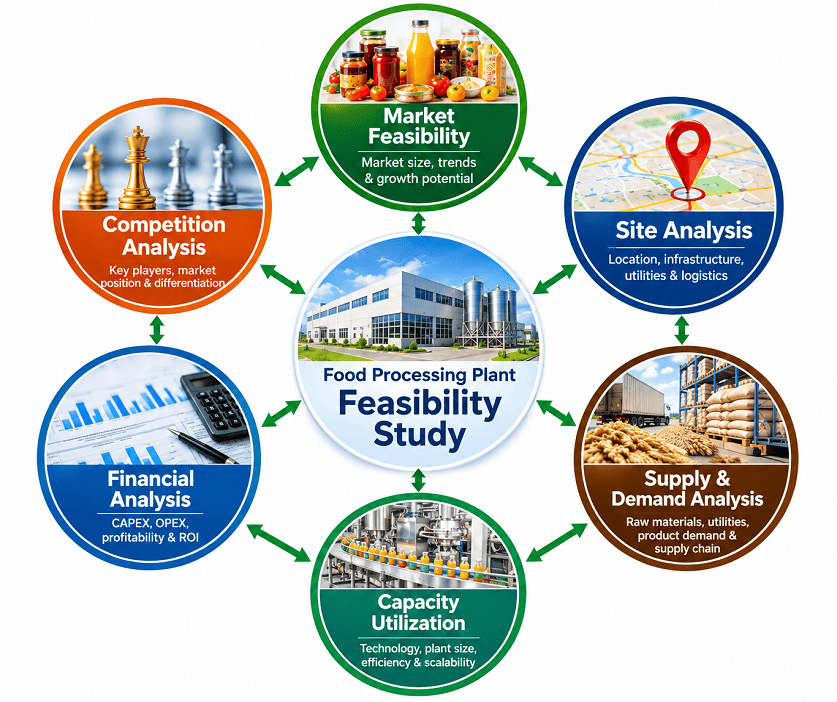
Food Processing Plant Feasibility Study
By Dr. Om Prakash Yadav
Integrated Consulting Solutions for the Food Industry
Food & Beverage | Project Feasibility | Project Management | Engineering | Business Advisory
Is Your Food Manufacturing Idea Commercially and Technically Feasible?
Setting up a food processing plant requires substantial investment in infrastructure, machinery, utilities, manpower, raw materials, and operational systems. However, a promising food business idea does not automatically translate into a successful manufacturing project.
Before committing significant capital, investors should understand whether the proposed project is technically practical, commercially viable, financially sustainable, and operationally manageable.
A comprehensive feasibility study helps bridge the gap between a business concept and a well-planned manufacturing facility.
At OmniEdge Solutions LLP, we support food businesses in evaluating project concepts, assessing technical requirements, developing manufacturing strategies, and preparing for project execution.
In this article, we discuss 10 essential factors every investor should consider before establishing a food processing plant.
1. Market Demand and Product Feasibility
Understanding the Market Before Investing
The first step in evaluating a food processing project is understanding the market opportunity for the proposed product.
Investors should assess whether the product addresses a genuine customer need and whether the anticipated demand can support the proposed manufacturing investment.
Key Considerations
- Target customer segments
- Market size and demand
- Competitor analysis
- Product positioning
- Expected selling price
- Distribution channels
- Domestic and export opportunities
- Product diversification
Example
An investor planning a breakfast cereal manufacturing plant may consider products such as:
- Oats
- Muesli
- Granola
- Corn flakes
- Multigrain cereals
Each product requires different processing technologies, raw materials, packaging formats, and investment levels.
The choice should be based on market opportunity, product requirements, manufacturing capabilities, and commercial objectives.
Practical Industry Insight: Market demand should guide production capacity. A plant designed around unrealistic sales assumptions can create underutilized machinery and financial pressure.
2. Product Selection and Manufacturing Technology
Choosing the Right Product and Process
Product selection directly influences the design and economics of a food processing facility.
Two products within the same food category may require substantially different manufacturing processes.
For example, a chocolate manufacturing plant may include different technologies for:
- Compound chocolate
- Filled chocolate
- Chocolate-coated products
- Chocolate bars
- Wafer products
The processing requirements, equipment configuration, raw materials, and quality controls can vary significantly.
Technical Evaluation Should Include
Product Characteristics
- Physical properties
- Moisture content
- Texture
- Shelf-life requirements
- Sensory characteristics
Processing Technology
- Batch or continuous processing
- Heating and cooling
- Mixing and homogenization
- Drying or baking
- Frying or extrusion
- Filling and packaging
Commercial Scale-Up
- Laboratory development
- Pilot trials
- Process validation
- Commercial production trials
Practical Industry Insight: A product that performs well in laboratory trials may require additional process development and equipment optimization before achieving consistent commercial production.
3. Production Capacity and Plant Utilization
How Much Should Your Plant Produce?
Determining the right production capacity is one of the most important decisions in a feasibility study.
Capacity affects:
- Capital investment
- Machinery selection
- Building size
- Utility requirements
- Workforce
- Working capital
- Production costs
Key Questions
1.What is the expected annual product demand?
2.What is the planned operating schedule?
3.What production volume is required per hour?
4.What product mix will be manufactured?
5.What level of future expansion is anticipated?
6.How much downtime should be expected?
Capacity Calculation Example
Suppose a proposed manufacturing plant has:
|
Parameter |
Illustrative Value |
|
Required annual production |
2,400 tonnes |
|
Operating days |
300 days |
|
Production hours per day |
8 hours |
|
Required average output |
1 tonne/hour |
|
Parameter |
Illustrative Value |
|
Required annual production |
2,400 tonnes |
|
Operating days |
300 days |
|
Production hours per day |
8 hours |
|
Required average output |
1 tonne/hour |
2,400 tonnes ÷ (300 × 8) = 1 tonne/hour
This is a simplified capacity calculation. Actual equipment selection must account for production losses, downtime, product changeovers, maintenance, and operating efficiency.
Practical Industry Insight: Installed capacity and actual saleable output are not the same. Feasibility studies should distinguish between nominal equipment capacity and realistic production performance.
4. Raw Material Availability and Supply Chain
A Reliable Manufacturing Plant Needs a Reliable Supply Chain
Raw materials represent a significant portion of operating costs in many food manufacturing businesses.
Variations in availability, quality, seasonality, and pricing can influence product consistency and profitability.
Areas to Evaluate
Raw Material Sourcing
- Local and regional suppliers
- Domestic versus imported materials
- Supplier reliability
- Seasonal availability
Quality Requirements
- Moisture
- Microbiological quality
- Purity
- Functional characteristics
- Contaminant controls
Storage and Handling
- Storage capacity
- Temperature and humidity
- Pest control
- FIFO / FEFO systems
- Material traceability
Cost Management
- Purchase prices
- Transportation
- Storage losses
- Inventory requirements
- Supply chain risks
Example: Cereal Processing
For an oats processing plant, the feasibility study may need to evaluate:
- Oat grain availability
- Grain quality and specifications
- Seasonal procurement
- Storage requirements
- Dehulling and cleaning losses
- Product yield
Practical Industry Insight: Raw material quality and yield assumptions should be validated through actual material evaluation and process trials wherever feasible.
5. Machinery Selection and Process Engineering
The Right Equipment Is More Than a Purchase Decision
Machinery selection influences product quality, production efficiency, maintenance requirements, and overall project cost.
Investors should evaluate the complete manufacturing process rather than selecting equipment solely on price or advertised capacity.
Important Technical Factors
Process Compatibility
Can the equipment meet the required product specifications?
Capacity
Does the equipment support the intended production volume and product mix?
Automation
What level of automation is suitable for the project?
Hygiene and Cleaning
Is the equipment appropriate for the required sanitation procedures?
Maintenance
Are spare parts, technical support, and service capabilities available?
Integration
Can the equipment work effectively with upstream and downstream systems?
Utility Requirements
What are the electrical, steam, water, compressed air, and refrigeration requirements?
Equipment evaluation framework
|
Evaluation Area |
Key Question |
|
Technology |
Is the process suitable for the product? |
|
Capacity |
Does it meet realistic output requirements? |
|
Quality |
Can it deliver consistent product quality? |
|
Hygiene |
Is it suitable for food manufacturing? |
|
Maintenance |
Is technical support available? |
|
Integration |
Can it connect with other equipment? |
|
Cost |
What is the total investment and operating impact? |
Practical Industry Insight: A technically suitable machine may still be inappropriate if it creates bottlenecks elsewhere in the process. The entire production line should be evaluated as an integrated system.
6. Plant Layout, Building, and Infrastructure
Designing a Facility for Efficient Operations
The physical infrastructure of a food processing plant must support production, hygiene, storage, maintenance, and employee safety.
A feasibility study should identify the infrastructure requirements before final investment decisions are made.
Key Infrastructure Areas
Production Areas
- Raw material preparation
- Processing
- Packaging
- Finished product handling
Storage
- Raw materials
- Packaging materials
- Finished goods
- Temperature-controlled storage, where required
Personnel Facilities
- Changing rooms
- Handwashing facilities
- Hygiene entry points
- Staff areas
Utility Areas
- Boiler and steam systems
- Electrical rooms
- Water treatment
- Compressed air
- Refrigeration
- HVAC
Waste Management
- Solid waste handling
- Wastewater collection
- ETP / STP requirements, where applicable
Plant Layout Principles
The layout should support:
- Efficient material flow
- Separation of incompatible activities
- Food safety and hygiene
- Equipment access
- Maintenance
- Future expansion
Practical Industry Insight: Building size should be determined by process requirements, storage, utilities, personnel movement, and expansion needs—not simply by the available plot area.
7. Utility Requirements and Engineering Feasibility
Utilities Can Influence Both Investment and Operating Costs
Food processing plants require reliable utility systems to maintain production and product quality.
Inadequate utility planning can result in production interruptions, additional investment, and operational inefficiencies.
Major Utility Requirements
|
Utility |
Areas of Assessment |
|
Electricity |
Connected load, demand, distribution |
|
Steam |
Process heating, boiler capacity |
|
Water |
Process, cleaning, potable requirements |
|
Compressed Air |
Pressure, flow, air quality |
|
Refrigeration |
Cooling and temperature control |
|
HVAC |
Environmental control and hygiene |
|
Effluent Treatment |
Wastewater characteristics and capacity |
|
Fire Protection |
Applicable safety systems |
Example: Steam Requirement
A food processing plant using steam for cooking, heating, or cleaning should evaluate:
- Maximum steam demand
- Average operating demand
- Boiler capacity
- Steam pressure
- Distribution losses
- Condensate recovery
- Future expansion
Steam demand should be established through equipment requirements and process calculations.
Practical Industry Insight: Utility requirements should be calculated during the feasibility and engineering stages. Waiting until equipment installation can lead to costly modifications.
8. Capital Investment and Financial Feasibility
Understanding the Complete Investment Requirement
A feasibility study must evaluate whether the proposed project can be supported by the investor's financial resources and expected business performance.
The analysis should include both initial investment and ongoing operating requirements.
Major Capital Expenditure Components
1.Land and site development
2.Building and civil works
3.Processing machinery
4.Packaging equipment
5.Utility systems
6.Electrical and engineering works
7.Installation and commissioning
8.Laboratory and quality infrastructure
9.Pre-operative expenses
10.Contingency allowances
Operating Expenditure
Operating costs may include:
- Raw materials
- Packaging
- Manpower
- Electricity
- Fuel
- Water
- Maintenance
- Quality testing
- Logistics
- Administrative expenses
Important Financial Indicators
Capital Expenditure (CAPEX)
Investment in fixed assets and project development.
Operating Expenditure (OPEX)
Recurring costs associated with manufacturing and business operations.
Gross Margin
Revenue less the relevant cost of goods sold.
Break-Even Analysis
The production or sales level at which revenue covers relevant fixed and variable costs.
Cash Flow Assessment
Evaluation of cash inflows and outflows over the project period.
Return on Investment (ROI)
A measure of investment returns relative to the investment base, subject to the selected calculation method.
The precise financial model should reflect the project type, accounting assumptions, financing structure, taxation, and operating projections.
Practical Industry Insight: A project may appear profitable on paper but face cash-flow challenges due to inventory requirements, customer credit periods, seasonal demand, or delayed ramp-up.
9. Regulatory Compliance and Food Safety Requirements
Compliance Should Be Planned Before Construction
Food processing projects must address applicable legal, regulatory, and food safety requirements.
The exact requirements depend on the product, process, location, and intended market.
For projects in India, the feasibility assessment may need to consider relevant FSSAI requirements along with other applicable statutory approvals.
Areas of Consideration
Food Safety
- HACCP-based hazard assessment
- GMP and hygiene practices
- Sanitation programs
- Food safety monitoring
- Traceability
Product Compliance
- Product standards
- Ingredients and additives
- Labelling requirements
- Packaging requirements
- Shelf-life evaluation
Statutory Approvals
- Applicable food licensing
- Environmental permissions
- Factory-related approvals
- Fire and workplace safety
- Other local requirements
Documentation
- SOPs
- Quality specifications
- Cleaning procedures
- Training records
- Validation and verification documents
Practical Industry Insight: Compliance requirements can influence the plant layout, equipment design, water systems, personnel movement, documentation, and operating costs. Early assessment helps reduce the risk of later modifications.
10. Project Execution, Commissioning, and Operational Readiness
Can the Project Be Implemented Successfully?
A project feasibility study should consider not only whether a plant can be designed, but also whether it can be implemented and operated effectively.
Many manufacturing projects involve multiple contractors, equipment suppliers, consultants, and internal teams.
Project Execution Considerations
Implementation Timeline
- Engineering
- Civil works
- Equipment procurement
- Installation
- Utility commissioning
- Product trials
Vendor Coordination
- Technical specifications
- Delivery schedules
- Equipment documentation
- Installation support
Commissioning
- Equipment testing
- Utility verification
- Process trials
- Product quality assessment
Manpower
- Recruitment
- Operator training
- Production supervision
- Maintenance support
- Food safety team
Operational Readiness
- SOPs
- Quality systems
- Raw material availability
- Packaging materials
- Maintenance plans
Example: Project Timeline
|
Project Stage |
Typical Activities |
|
Feasibility |
Concept, market, technical, financial assessment |
|
Planning |
Capacity, process flow, layout, budget |
|
Engineering |
Detailed design and utility planning |
|
Procurement |
Vendor selection and equipment manufacturing |
|
Construction |
Building and infrastructure |
|
Installation |
Equipment, piping, electrical works |
|
Commissioning |
Testing and product trials |
|
Handover |
Training, documentation, operational readiness |
An illustrative greenfield food processing project may follow this sequence. Actual timelines depend on project size, technology, approvals, construction requirements, and procurement lead times.
Practical Industry Insight: Project schedules should account for dependencies. Equipment installation cannot always proceed independently of building completion, utility readiness, and engineering coordination.
Bonus Consideration: Product Quality, Yield, and Process Validation
Although these factors are addressed across the feasibility study, they deserve particular attention.
A manufacturing project should establish how product quality and process performance will be measured.
Important Areas
- Raw material-to-finished product yield
- Product quality specifications
- Process losses
- Rework and rejection
- Production consistency
- Shelf-life requirements
- Cleaning and sanitation
- Process validation
Why This Matters
A plant may achieve its target production volume while experiencing excessive material losses or inconsistent product quality.
Therefore, technical feasibility should evaluate saleable output, not just production throughput.
Feasibility Study: A Practical Investor Checklist
Before proceeding with a major food manufacturing investment, review the following areas.
|
No. |
Assessment Area |
Status |
|
1 |
Market and product feasibility |
☐ |
|
2 |
Product and technology selection |
☐ |
|
3 |
Production capacity |
☐ |
|
4 |
Raw material availability |
☐ |
|
5 |
Machinery selection |
☐ |
|
6 |
Plant layout and infrastructure |
☐ |
|
7 |
Utility requirements |
☐ |
|
8 |
Capital and operating costs |
☐ |
|
9 |
Regulatory compliance |
☐ |
|
10 |
Project execution and commissioning |
☐ |
This checklist is a preliminary planning aid. A detailed feasibility study should be developed based on the specific product, location, capacity, and investment objectives.
How OmniEdge Solutions LLP Supports Project Feasibility
At OmniEdge Solutions LLP, we help food businesses evaluate manufacturing opportunities and develop a structured foundation for project execution.
Our consulting approach connects commercial considerations with technical and operational requirements.
Our Project Feasibility Support Includes
1. Project Ideation & Concept Evaluation
- Business concept assessment
- Product and capacity discussions
- Preliminary project planning
2. Technical Feasibility
- Process flow development
- Equipment requirement assessment
- Utility evaluation
- Plant layout considerations
3. Commercial & Financial Assessment
- Preliminary investment estimation
- Operating cost considerations
- Manufacturing economics
- Project assumptions
4. Engineering & Infrastructure
- Process engineering
- Equipment integration
- MEP coordination
- Infrastructure planning
5. Food Safety & Regulatory
- Applicable compliance assessment
- HACCP and GMP considerations
- Quality system planning
6. Project Management & Implementation
- Project execution planning
- Vendor coordination
- Installation and commissioning support
- Operational readiness
7. Process Optimization & Technical Advisory
- Manufacturing efficiency
- Yield improvement
- Troubleshooting
- Production support
Our objective is to help clients develop informed project plans that reflect their business objectives, technical requirements, and operational realities.
Conclusion: Make Informed Decisions Before Investing in a Food Processing Plant
A feasibility study is an important foundation for food manufacturing project planning.
It helps investors understand the relationship between market opportunity, manufacturing technology, capital investment, operating costs, infrastructure, compliance, and project execution.
The objective of feasibility is not simply to establish whether a project can be built, but to understand the conditions required for its successful implementation and operation.
A well-structured assessment can help identify critical requirements, highlight potential risks, and support more informed investment planning.
At OmniEdge Solutions LLP, we combine food-industry consulting, technical expertise, engineering coordination, and project management support to help businesses move from concept toward practical manufacturing solutions.
Planning to Set Up a Food Processing Plant?
Let's Evaluate Your Project Together.
Whether you are planning a new food manufacturing facility, expanding an existing plant, developing a new product, or evaluating a processing technology, OmniEdge Solutions LLP can support your project planning and technical consulting requirements.
Our Expertise Includes:
- Project Ideation & Feasibility
- Project Management Consulting
- New Product Development
- Process Optimization
- Regulatory Compliance
- Engineering Services & MEP
- Turnkey Solutions
- Business Advisory
OmniEdge Solutions LLP
Integrated Consulting Solutions for the Food Industry
Complete Solutions. Competitive Edge.
Whatsapp Now Call Now