
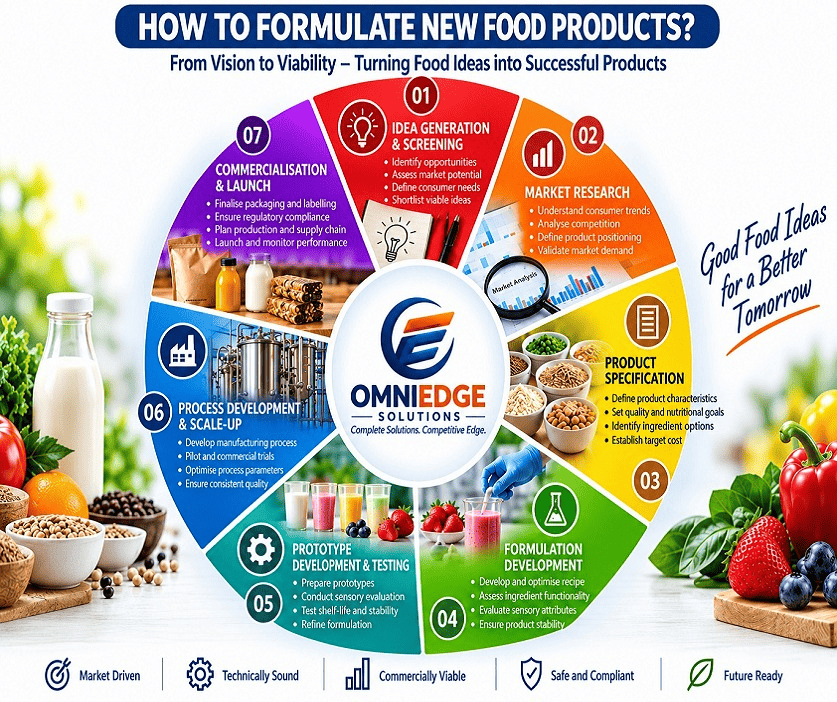
From Vision to Viability: Turning Food Industry Ideas into Feasible Projects
How to Formulate New Food Products?
From Vision to Viability: Turning Food Industry Ideas into Feasible Projects
Every successful food product begins with an idea. It may originate from a market opportunity, consumer demand, customer requirement, manufacturing capability, or the vision of an entrepreneur.
However, transforming an idea into a commercially successful food product requires much more than developing a recipe. It involves product concept development, formulation, ingredient selection, process design, food safety, regulatory compliance, shelf-life evaluation, costing, and commercial-scale production.
A product that performs well in a laboratory may not necessarily be commercially viable. Its cost may be high, the process may be difficult to scale, the ingredients may be inconsistent, or the product may fail to meet consumer expectations.
At OmniEdge Solutions LLP, we support entrepreneurs, startups, SMEs, and established food businesses in converting product ideas into technically feasible, commercially viable, and scalable food manufacturing opportunities.
Our approach connects New Product Development (NPD) with Project Ideation, Feasibility, Process Engineering, and Commercialisation.
1. Understanding the Product Concept
The first step in new product formulation is to clearly define the product concept.
Before beginning laboratory trials, it is important to understand:
-
What product is being developed?
-
Who is the target consumer?
-
What consumer problem does the product solve?
-
What makes the product different from existing products?
-
Which market segment will it serve?
-
What price range is expected?
-
What packaging format is required?
-
What production volume is anticipated?
For example, a business may wish to develop:
-
High-protein snack bars
-
Millet-based breakfast cereals
-
Sugar-free confectionery
-
Functional beverages
-
Instant food mixes
-
Plant-based dairy alternatives
-
Premium chocolates
-
Frozen ready-to-eat products
-
Bakery and snack products
-
Nutraceutical and fortified food products
Each product category requires a different approach to formulation, processing, packaging, quality control, and regulatory assessment.
A clearly defined product concept provides direction for all subsequent development activities.
2. Market Research and Consumer Understanding
A technically excellent product may not succeed if it does not meet market expectations.
Market research helps determine whether the proposed product has a realistic commercial opportunity.
Important areas of evaluation include:
Target Market
-
Retail consumers
-
Institutional buyers
-
Food service operators
-
Export markets
-
Industrial ingredient users
-
Private-label customers
-
E-commerce consumers
Consumer Preferences
-
Taste and flavour
-
Texture and mouthfeel
-
Nutritional profile
-
Convenience
-
Portion size
-
Packaging
-
Price sensitivity
-
Health and wellness expectations
Competitor Analysis
The proposed product should be evaluated against existing products based on:
-
Ingredients
-
Product quality
-
Sensory characteristics
-
Pack size
-
Selling price
-
Shelf life
-
Product positioning
-
Distribution channels
Market Opportunity
The assessment should also consider whether the product can be manufactured and sold at a price that supports the expected profit margin.
Product formulation should be guided by both technical requirements and market expectations.
3. Defining Product Specifications
Once the concept is established, the next step is to prepare a preliminary product specification.
A product specification establishes the expected characteristics and performance of the final product.
It may include:
|
Parameter |
Example Requirement |
|
Product name |
Chocolate-coated cereal bar |
|
Appearance |
Uniform shape and coating |
|
Colour |
Product-specific |
|
Flavour |
Characteristic chocolate and cereal flavour |
|
Texture |
Crisp, chewy, or crunchy |
|
Moisture |
Defined according to product requirements |
|
Water activity |
Established for stability and safety |
|
Weight |
Target net weight per piece |
|
Shelf life |
Based on validation studies |
|
Packaging |
Suitable barrier packaging |
|
Microbiological quality |
Within applicable requirements |
|
Nutritional profile |
Based on formulation and applicable rules |
The specification should be realistic, measurable, and aligned with the intended manufacturing process.
-
Product Name: Chocolate-coated cereal bar
-
Appearance: Uniform shape and coating
-
Colour: Product-specific
-
Flavour: Characteristic chocolate and cereal flavour
-
Texture: Crisp, chewy, or crunchy
-
Moisture: Defined according to product requirements
-
Water Activity: Established for stability and safety
-
Weight: Target net weight per piece
-
Shelf Life: Based on validation studies
-
Packaging: Suitable barrier packaging
-
Microbiological Quality: Within applicable requirements
-
Nutritional Profile: Based on formulation and applicable rules
The specification should be realistic, measurable, and aligned with the intended manufacturing process.
4. Ingredient Selection and Functionality
Ingredient selection is one of the most important stages of food product formulation.
Ingredients should not be selected only on the basis of availability or price. Their functional properties, compatibility, processing behaviour, quality consistency, and regulatory status must also be considered.
Important Ingredient Evaluation Parameters
-
Functional performance
-
Nutritional contribution
-
Flavour and aroma
-
Colour
-
Solubility
-
Water absorption
-
Emulsification properties
-
Binding characteristics
-
Thermal stability
-
Oxidative stability
-
Interaction with other ingredients
-
Availability and supply consistency
-
Cost and minimum order quantity
For example:
-
Starch may influence viscosity, texture, and gel formation.
-
Hydrocolloids may improve stability and mouthfeel.
-
Emulsifiers may support the formation and stability of emulsions.
-
Fats influence texture, flavour release, and product structure.
-
Sugars contribute to sweetness, solids, colour, and texture.
-
Proteins may affect nutrition, water binding, and product structure.
-
Acids may influence pH, flavour, preservation, and processing behaviour.
The technical function of each ingredient should be understood before finalising the formulation.
5. Developing the Initial Formulation
The initial formulation is prepared based on the product concept, desired characteristics, ingredient functionality, and target cost.
At this stage, the formulation may be developed through:
1.Existing technical knowledge
2.Ingredient supplier information
3.Published technical references
4.Benchmark product analysis
5.Laboratory experimentation
6.Pilot-scale trials
The first formulation should be treated as a starting point rather than a final commercial recipe.
During development, several parameters may need adjustment:
-
Ingredient ratios
-
Moisture content
-
Solids level
-
Fat percentage
-
Sugar level
-
pH
-
Viscosity
-
Mixing time
-
Processing temperature
-
Baking or cooking time
-
Cooling conditions
-
Binding strength
-
Product density
The objective is to achieve the required product characteristics while maintaining process reliability and commercial feasibility.
6. Laboratory Trials and Product Development
Laboratory trials help determine whether the proposed formulation can deliver the desired product characteristics.
A structured trial process should be followed instead of making uncontrolled changes.
Typical Development Process
Initial Formulation → Laboratory Trial → Evaluation → Modification → Repeat Trial → Standardisation
During each trial, the following information should be recorded:
-
Trial number
-
Date of development
-
Ingredient quantities
-
Supplier and batch details
-
Processing conditions
-
Mixing and heating parameters
-
Product yield
-
Sensory observations
-
Physical and chemical results
-
Defects observed
-
Corrective actions
A controlled trial record helps identify which formulation or process changes are responsible for improvements or failures.
Sensory Evaluation
The product may be evaluated for:
-
Appearance
-
Colour
-
Aroma
-
Taste
-
Texture
-
Mouthfeel
-
Aftertaste
-
Overall acceptability
Where appropriate, sensory evaluation should be conducted using a structured and suitable method.
7. Process Development and Standardisation
A successful formulation must be compatible with a repeatable manufacturing process.
The same recipe may produce different results when processed using different:
-
Mixing equipment
-
Heating systems
-
Cooking conditions
-
Cooling methods
-
Filling systems
-
Baking ovens
-
Extrusion systems
-
Homogenisation equipment
-
Packaging machines
Therefore, formulation development and process development should progress together.
Process Parameters May Include
-
Ingredient addition sequence
-
Mixing speed and duration
-
Heating temperature
-
Holding time
-
Pressure
-
Product moisture
-
Cooling rate
-
Filling temperature
-
Homogenisation pressure
-
Baking temperature
-
Frying time
-
Drying conditions
-
Packaging environment
Process standardisation helps ensure that the product maintains consistent quality during repeated production.
8. Pilot-Scale Trials and Scale-Up
A product that performs well in the laboratory may behave differently at pilot or commercial scale.
Scale-up can introduce several challenges, including:
-
Uneven mixing
-
Heat transfer variation
-
Longer processing time
-
Changes in moisture distribution
-
Product sticking
-
Inconsistent texture
-
Variation in yield
-
Increased product losses
-
Equipment limitations
-
Packaging difficulties
Pilot-scale trials help identify these challenges before commercial production.
Scale-Up Evaluation
The following factors should be assessed:
-
Batch size
-
Equipment working capacity
-
Heat transfer
-
Mixing efficiency
-
Product residence time
-
Energy consumption
-
Yield and process losses
-
Cleaning requirements
-
Operator involvement
-
Product consistency
Scale-up should be based on process understanding rather than simply multiplying the laboratory recipe.
9. Nutritional and Functional Product Development
Many modern food products are developed to deliver specific nutritional or functional benefits.
Examples include:
-
High-protein products
-
High-fibre products
-
Fortified foods
-
Reduced-sugar products
-
Reduced-fat products
-
Gluten-free products
-
Plant-based products
-
Functional beverages
-
Nutraceutical products
-
Products containing vitamins and minerals
Such products require additional evaluation because changes in formulation may affect:
-
Taste
-
Texture
-
Stability
-
Solubility
-
Digestibility
-
Processing performance
-
Shelf life
-
Consumer acceptability
-
Regulatory declarations
Any nutritional or functional claim should be evaluated against the applicable regulatory requirements and supported by appropriate evidence.
10. Food Safety and Regulatory Considerations
Food safety and regulatory compliance should be considered from the early stages of product development.
The formulation and manufacturing process should be assessed for:
-
Permitted ingredients
-
Food additives
-
Allergen management
-
Microbiological safety
-
Contaminant risks
-
Processing hazards
-
Product category classification
-
Labelling requirements
-
Nutritional declarations
-
Claims and communication
-
Packaging suitability
The applicable requirements may depend on the product category, ingredients, processing method, intended market, and country of sale.
Food Safety Assessment
The development process should consider:
-
Raw material specifications
-
Supplier approval
-
Hazard identification
-
Critical processing parameters
-
Cross-contamination controls
-
Cleaning and sanitation
-
Personnel hygiene
-
Storage conditions
-
Finished product testing
Regulatory and food safety requirements should be integrated into the formulation rather than addressed only after the product has been developed.
11. Shelf-Life and Stability Evaluation
Shelf life is a critical factor in determining the commercial suitability of a food product.
A product may initially meet the required quality standards but deteriorate during storage due to:
-
Moisture migration
-
Oxidation
-
Microbial growth
-
Flavour deterioration
-
Colour changes
-
Texture loss
-
Separation
-
Rancidity
-
Packaging failure
Shelf-life evaluation should be designed according to the product's characteristics and intended storage conditions.
Important Evaluation Parameters
-
Moisture
-
Water activity
-
pH
-
Acidity
-
Microbiological quality
-
Oxidative stability
-
Sensory quality
-
Texture
-
Packaging integrity
-
Storage temperature and humidity
Shelf-life claims should be supported by suitable testing and documented justification.
12. Packaging Development and Compatibility
Packaging is not only a method of protecting the product. It also influences shelf life, logistics, presentation, and customer acceptance.
Packaging selection should consider:
-
Product sensitivity
-
Moisture barrier
-
Oxygen barrier
-
Light protection
-
Mechanical strength
-
Sealing performance
-
Product-contact suitability
-
Filling and packing equipment
-
Transportation conditions
-
Storage environment
-
Cost and sustainability
For example, a moisture-sensitive snack may require suitable moisture-barrier packaging, while an oxidation-sensitive product may require protection from oxygen.
Packaging trials should verify:
-
Pack integrity
-
Seal strength
-
Leakage
-
Product protection
-
Compatibility with filling machines
-
Shelf-life performance
-
Print and labelling requirements
13. Product Costing and Commercial Viability
A technically successful product must also be commercially viable.
Product costing should be conducted during the development process rather than after finalisation.
Key Cost Components
-
Raw materials
-
Food additives and ingredients
-
Packaging materials
-
Direct labour
-
Utilities
-
Processing losses
-
Quality testing
-
Maintenance
-
Production overheads
-
Warehousing
-
Logistics
-
Rejections and wastage
The formulation may need to be optimised to achieve a balance between:
Product Quality + Consumer Acceptance + Manufacturing Cost + Selling Price
Cost optimisation should not compromise food safety, regulatory compliance, or essential product quality.
Illustrative Costing Questions
-
Is the ingredient cost compatible with the target selling price?
-
Can the product be manufactured at the required capacity?
-
Are the raw materials consistently available?
-
Is the packaging cost commercially acceptable?
-
What is the expected production yield?
-
What are the expected process losses?
-
Can the product generate the required contribution margin?
14. Manufacturing Feasibility Assessment
Once the formulation has reached a suitable stage, the proposed manufacturing process should be evaluated for commercial feasibility.
This assessment may include:
Production Capacity
-
Expected production per hour
-
Daily production requirement
-
Number of shifts
-
Batch size
-
Seasonal demand
-
Future expansion requirements
Machinery Requirements
-
Processing equipment
-
Mixing and blending systems
-
Heating or cooking equipment
-
Filling and forming machines
-
Cooling and drying systems
-
Packaging equipment
-
Inspection and quality-control systems
Utility Requirements
-
Electricity
-
Steam
-
Compressed air
-
Water
-
Refrigeration
-
HVAC
-
Drainage
-
Effluent treatment
Infrastructure Requirements
-
Production area
-
Raw material storage
-
Packaging material storage
-
Finished goods warehouse
-
Quality laboratory
-
Personnel facilities
-
Cleaning and sanitation areas
A product should not be considered fully commercialised until the manufacturing requirements have been assessed.
15. Product Development Documentation
Proper documentation is essential for maintaining consistency and supporting future commercial production.
Important documents may include:
-
Product concept brief
-
Formulation sheet
-
Ingredient specifications
-
Trial records
-
Process flow diagram
-
Product specification
-
Packaging specification
-
Sensory evaluation records
-
Laboratory test reports
-
Shelf-life study records
-
Cleaning and sanitation requirements
-
Quality-control plan
-
Manufacturing instructions
-
Costing sheet
-
Regulatory review
-
Scale-up report
Well-maintained documentation supports knowledge transfer between product development, production, quality assurance, procurement, and commercial teams.
16. Common Challenges in New Product Formulation
Food businesses often face challenges during product development, including:
1. Product Quality Variation
Variation in raw materials or process conditions may lead to inconsistent finished products.
2. High Manufacturing Cost
A formulation may be technically successful but too expensive for the intended market.
3. Difficulty in Scale-Up
The product may perform well in the laboratory but fail during commercial production.
4. Short Shelf Life
The product may experience microbial, chemical, or physical deterioration during storage.
5. Ingredient Availability
Specialised ingredients may have limited availability or inconsistent supply.
6. Regulatory Limitations
Certain ingredients, additives, claims, or product categories may require additional regulatory assessment.
7. Packaging Problems
Inadequate packaging may result in moisture absorption, oxidation, leakage, or product damage.
8. Lack of Process Standardisation
Without defined operating parameters, product quality may vary between batches.
A structured product development approach helps identify and address these challenges at an early stage.
17. How OmniEdge Solutions LLP Supports New Product Development
At OmniEdge Solutions LLP, we support food businesses throughout the product development and commercialisation journey.
Our support may include:
Product Concept Development
-
Understanding the product vision
-
Defining product objectives
-
Identifying target markets
-
Developing product specifications
Formulation Development
-
Ingredient selection
-
Recipe development
-
Laboratory trials
-
Product improvement
-
Sensory evaluation
-
Nutritional positioning
Process Development
-
Process flow development
-
Processing parameter evaluation
-
Pilot-scale trials
-
Scale-up support
-
Process standardisation
Feasibility and Commercial Assessment
-
Manufacturing feasibility
-
Capacity planning
-
Machinery assessment
-
Utility evaluation
-
Cost estimation
-
Commercial viability assessment
Regulatory and Food Safety Support
-
Product category assessment
-
Ingredient and additive review
-
Labelling considerations
-
Food safety evaluation
-
Quality documentation
Commercialisation Support
-
Production readiness
-
Vendor coordination
-
Equipment selection
-
Plant layout coordination
-
Trial production
-
Commissioning support
-
Process optimisation
Our integrated approach helps connect product innovation with the practical requirements of manufacturing and business development.
18. From Product Idea to Commercial Success
New product development is not limited to preparing a formulation. It is a multidisciplinary process involving:
Concept Development → Market Assessment → Formulation → Laboratory Trials → Process Development → Pilot Trials → Scale-Up → Regulatory Review → Packaging → Costing → Commercialisation
Each stage influences the success of the next.
A well-formulated product must also be:
-
Safe
-
Consistent
-
Scalable
-
Cost-effective
-
Regulatory compliant
-
Consumer-oriented
-
Suitable for commercial manufacturing
The earlier technical and commercial challenges are identified, the easier it becomes to manage development costs, reduce project risks, and improve the probability of successful commercialisation.
Conclusion
Formulating a new food product requires a combination of scientific knowledge, practical processing experience, consumer understanding, regulatory awareness, and commercial planning.
A promising product idea becomes a successful business opportunity only when its formulation, manufacturing process, cost structure, quality, packaging, and market potential are evaluated together.
At OmniEdge Solutions LLP, we help businesses move from product vision to technical development and commercial feasibility through integrated consulting, product development, engineering, and project management support.
We don’t just develop products—we help build practical, scalable, and commercially viable food manufacturing solutions.
Let’s Develop Your Next Food Product
Whether you are planning a new food product, expanding your existing portfolio, developing a private-label product, or establishing a new manufacturing facility, OmniEdge Solutions LLP can support your journey from concept to commercial production.
Contact us to discuss your product idea and explore its technical and commercial feasibility.
DeveloperTest
Whatsapp Now Call Now