
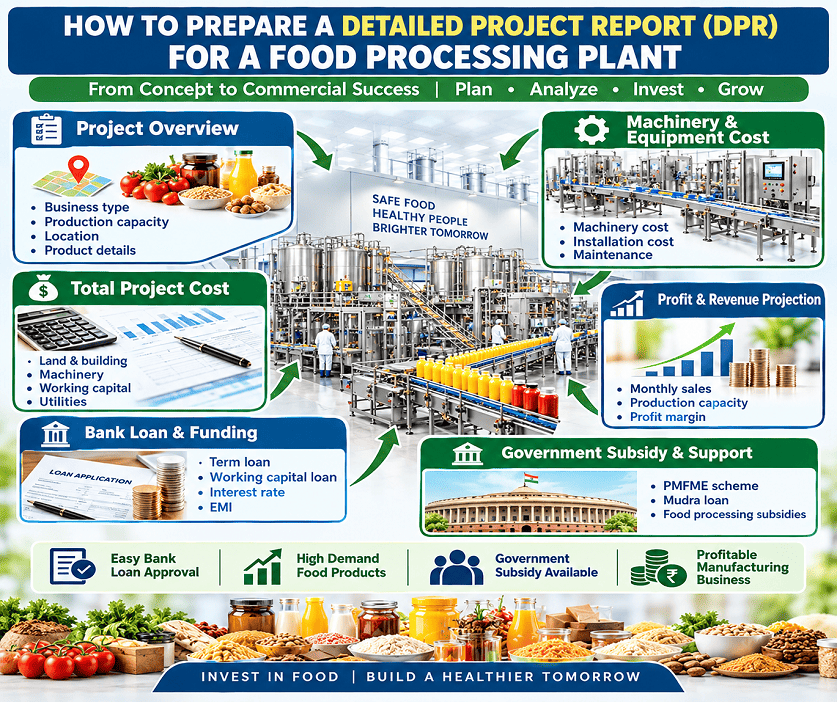
How To Prepare A Detailed Project Report (DPR) For A Food Processing Plant
By OmniEdge Solutions LLP
Integrated Consulting Solutions for the Food Industry
Food & Beverage | Project Feasibility | Project Management | Engineering | Business Advisory
Introduction: Turning a Business Concept into an Execution-Ready Project
Establishing a food processing plant requires careful planning, technical evaluation, financial assessment, and coordinated execution. While a feasibility study helps determine whether a project is worth pursuing, a Detailed Project Report (DPR) provides a structured framework for understanding how the project can be developed, funded, implemented, and operated.
A well-prepared DPR connects the business concept with practical manufacturing requirements, including production capacity, process technology, equipment selection, infrastructure, manpower, investment, operating costs, and project implementation.
For investors, entrepreneurs, and food manufacturing companies, a DPR serves as an important planning document for making informed decisions and communicating project requirements to stakeholders, financial institutions, equipment suppliers, and implementation teams.
At OmniEdge Solutions LLP, we support food businesses in developing project concepts, assessing technical feasibility, coordinating engineering requirements, and planning manufacturing projects across the Food, Beverage, Nutraceutical, and Allied Processing Industries.
In this guide, we explain the key components of a comprehensive DPR for a food processing plant.
1. What Is a Detailed Project Report (DPR)?
A Detailed Project Report is a structured document that describes the proposed project from commercial, technical, financial, operational, and implementation perspectives.
It should provide sufficient information to help stakeholders understand:
- What the project intends to manufacture
- Why the project is being proposed
- How the products will be manufactured
- What infrastructure and machinery are required
- How much investment may be needed
- What operating costs are anticipated
- How the project will be implemented
- What risks and assumptions affect the project
A DPR is not simply a machinery quotation or a financial spreadsheet. It should integrate the major project components into a coherent plan.
Difference Between a Feasibility Study and a DPR
|
Parameter |
Description |
|
Product Name |
Proposed manufactured product |
|
Product Category |
Cereal, snack, beverage, dairy, etc. |
|
Product Format |
Powder, bar, flake, liquid, etc. |
|
Target Market |
B2B, retail, institutional, export |
|
Packaging Format |
Pouch, carton, bottle, bulk |
|
Expected Output |
Capacity by product |
|
Quality Requirements |
Product-specific parameters |
|
Shelf-Life Objective |
Intended product shelf life |
|
Future Variants |
Potential expansion products |
The level of detail should be appropriate to the project stage. A preliminary DPR may be suitable for early investment discussions, while a lender-facing or execution-oriented report generally requires more comprehensive evidence and documentation.
Practical Industry Insight: A DPR should evolve as the project develops. Preliminary assumptions should be replaced with validated data, supplier quotations, engineering calculations, and actual project decisions wherever possible.
2. Define the Project Background and Business Objectives
Every DPR should begin by explaining the background of the proposed project.
This section provides context for the investment and establishes the objectives that the technical and financial plans must support.
Key Information to Include
- Name of the project
- Proposed location
- Promoter or company background
- Nature of the business
- Product categories
- Target markets
- Project objectives
- Proposed production capacity
- Expansion plans
- Estimated investment range
Example
Project: Integrated Oats Processing and Flaking Plant
Proposed Products:
- Jumbo Oats
- Quick Cooking Oats
- Steel Cut Oats
- Oats Flour
Project Objectives:
- Establish a commercial oats processing facility
- Produce multiple product formats
- Develop consistent processing and quality systems
- Serve B2B and potential retail markets
- Provide capacity for future expansion
The example is illustrative; actual project objectives and capacities should be based on the investor's requirements.
Why This Section Matters
A clearly defined business objective helps align the project's:
- Manufacturing technology
- Investment level
- Plant capacity
- Product portfolio
- Infrastructure
- Commercial strategy
Practical Industry Insight: A DPR should explain the business purpose behind the project, not just list the equipment that will be purchased.
3. Prepare a Market and Commercial Assessment
A food processing plant needs a commercial strategy that supports sustainable operations.
The DPR should describe the proposed market, customer segments, competitive environment, and intended sales channels.
3.1 Product and Market Overview
Describe the proposed products, their intended applications, and the customers they are expected to serve.
For example:
- B2B ingredient supply
- Retail consumer products
- Institutional sales
- Foodservice
- Export markets
3.2 Market Demand
Assess the available market information, anticipated demand, and factors affecting sales.
Useful inputs may include:
- Market research
- Customer discussions
- Existing sales data
- Distributor feedback
- Competitor analysis
- Industry reports
3.3 Product Positioning
Explain how the proposed products will compete.
Possible positioning factors include:
- Product quality
- Price
- Convenience
- Nutrition
- Packaging
- Product innovation
- Customer service
3.4 Sales and Distribution
Describe the proposed:
- Sales channels
- Geographic markets
- Distribution network
- Customer acquisition strategy
- Expected sales mix
Practical Example
A company planning a cereal processing facility may have two commercial options:
Option A: Supply processed oats as an ingredient to established food manufacturers.
Option B: Develop branded retail products for direct consumer sales.
Both models can involve different packaging, marketing, working capital, quality requirements, and distribution arrangements.
The DPR should identify the proposed commercial model and its implications.
Practical Industry Insight: Production capacity should be supported by realistic sales assumptions. Market demand, production planning, and investment should be evaluated together.
4. Develop a Detailed Product Portfolio
The product portfolio defines what the plant will manufacture and influences the entire technical design.
A DPR should clearly identify the products included in the initial project and distinguish them from potential future products.
Product Details to Include
|
Parameter |
Description |
|
Product Name |
Proposed manufactured product |
|
Product Category |
Cereal, snack, beverage, dairy, etc. |
|
Product Format |
Powder, bar, flake, liquid, etc. |
|
Target Market |
B2B, retail, institutional, export |
|
Packaging Format |
Pouch, carton, bottle, bulk |
|
Expected Output |
Capacity by product |
|
Quality Requirements |
Product-specific parameters |
|
Shelf-Life Objective |
Intended product shelf life |
|
Future Variants |
Potential expansion products |
Example: Confectionery Project
A confectionery manufacturing project may include:
- Sugar-boiled confectionery
- Toffees
- Filled candies
- Chocolate-coated products
Each product may require different processing conditions, equipment configurations, packaging systems, and quality controls.
The DPR should explain whether the proposed equipment can support the intended product range.
Practical Industry Insight: A broad product portfolio may improve commercial flexibility but can also increase complexity in equipment, changeovers, inventory, and quality management.
5. Describe the Manufacturing Process in Detail
The manufacturing process section is one of the most important components of a technical DPR.
It should explain how raw materials will be converted into finished products through defined processing stages.
Process Description Should Include
- Raw material receiving
- Storage and handling
- Preparation
- Processing
- Intermediate handling
- Quality checks
- Packaging
- Finished goods storage
- Dispatch
Example: Oats Processing Plant
A simplified process flow may include:
Raw Oats Receiving → Cleaning → Grading → Dehulling → Separation → Kilning / Stabilization, Where Applicable → Flaking or Cutting → Screening → Packaging
The exact process depends on the product portfolio, technology, quality requirements, and plant configuration.
Technical Details to Document
For each major process stage, consider:
- Process purpose
- Input material
- Output material
- Equipment required
- Capacity
- Process parameters
- Material losses
- Quality checks
- Utility requirements
Process Flow Diagram (PFD)
A process flow diagram should visually represent the major processing stages and material movement.
For complex projects, additional diagrams may be required, including:
- Equipment flow diagrams
- Piping and instrumentation diagrams
- Utility flow diagrams
- Material balance diagrams
Practical Industry Insight: The process flow should be finalized before detailed equipment selection and plant layout development. Changes at a later stage can affect several interconnected project components.
6. Determine Production Capacity and Material Balance
The DPR should establish the proposed production capacity and the assumptions behind it.
Capacity should be assessed against market demand, operating schedules, process yields, and equipment capabilities.
Important Parameters
- Raw material input per hour
- Finished product output
- Operating hours per day
- Operating days per year
- Batch size, where applicable
- Process yield
- Production losses
- Planned downtime
- Product changeovers
Example: Capacity Calculation
|
Equipment Parameter |
What to Document |
|
Equipment Name |
Specific process function |
|
Capacity |
Required throughput or batch size |
|
Material of Construction |
Suitable construction materials |
|
Power Requirement |
Electrical load |
|
Utility Requirement |
Steam, water, air, etc. |
|
Automation |
Manual, semi-automatic, automatic |
|
Product Contact |
Hygiene and material compatibility |
|
Installation |
Space and access requirements |
|
Maintenance |
Service and spare parts |
|
Vendor |
Proposed or shortlisted supplier |
Suppose a proposed plant has:
2,400 ÷ (300 × 8) = 1 tonne/hour
This is a simplified calculation. Actual design capacity may need to be higher to account for downtime, yield losses, changeovers, and production constraints.
Material Balance
A material balance tracks inputs and outputs throughout the manufacturing process.
For example:
Raw Material Input → Processing Losses + By-Products + Finished Product
A detailed material balance can help estimate:
- Raw material requirements
- Process yield
- Waste generation
- Finished product output
- Storage requirements
- Production costs
Why Material Balance Matters
Incorrect yield assumptions can lead to inaccurate raw material budgets and profitability projections.
Practical Industry Insight: Yield should be validated using suitable process data, trials, historical performance, or technically supported assumptions.
7. Select Machinery and Prepare Equipment Specifications
The DPR should identify the major equipment required for the proposed manufacturing process.
However, equipment selection should be supported by technical requirements rather than based only on supplier availability or purchase price.
Equipment Details to Include
|
Equipment Parameter |
What to Document |
|
Equipment Name |
Specific process function |
|
Capacity |
Required throughput or batch size |
|
Material of Construction |
Suitable construction materials |
|
Power Requirement |
Electrical load |
|
Utility Requirement |
Steam, water, air, etc. |
|
Automation |
Manual, semi-automatic, automatic |
|
Product Contact |
Hygiene and material compatibility |
|
Installation |
Space and access requirements |
|
Maintenance |
Service and spare parts |
|
Vendor |
Proposed or shortlisted supplier |
Example: Biscuit Manufacturing Project
A biscuit project may require equipment such as:
- Flour handling and dosing
- Mixing
- Forming
- Baking
- Cooling
- Packaging
The final configuration depends on product type, capacity, process technology, and commercial requirements.
Equipment Selection Process
1.Define product and process specifications.
2.Determine required capacity.
3.Prepare equipment datasheets.
4.Identify suitable suppliers.
5.Obtain and evaluate technical quotations.
6.Review utility and integration requirements.
7.Assess installation and maintenance considerations.
8.Finalize the equipment basis for the project.
Practical Industry Insight: A DPR should distinguish between preliminary equipment estimates and technically confirmed specifications. Supplier quotations may change as the project design becomes more detailed.
8. Develop the Plant Layout and Infrastructure Plan
The DPR should explain the proposed plant infrastructure and how it will support manufacturing operations.
The layout should be developed based on process flow, hygiene requirements, equipment dimensions, material movement, and future needs.
Major Layout Areas
Production
- Raw material preparation
- Processing
- Packaging
- Finished product handling
Storage
- Raw materials
- Packaging materials
- Finished products
- Temperature-controlled storage, where required
Support Areas
- Quality laboratory
- Maintenance workshop
- Utility rooms
- Staff facilities
- Offices
Hygiene and Safety
- Personnel movement
- Hygiene entry points
- Drainage
- Cleaning facilities
- Emergency access
Infrastructure Planning
The DPR may include:
- Proposed land area
- Building area
- Production area
- Warehouse area
- Utility area
- Roads and site development
- Expansion provisions
The final space requirements should be established through a coordinated layout and equipment plan.
Practical Industry Insight: A plant layout should accommodate both current production and practical maintenance, cleaning, and material handling requirements.
9. Calculate Utility Requirements and MEP Scope
Utility planning is essential for establishing the technical and financial requirements of a food processing plant.
The DPR should identify the major utility systems and provide preliminary or detailed calculations appropriate to the project stage.
Major Utility Systems
|
System |
Requirements to Evaluate |
|
Electrical |
Connected load, demand, distribution |
|
Steam |
Boiler capacity, pressure, consumption |
|
Water |
Process, cleaning, potable requirements |
|
Compressed Air |
Pressure, flow, quality |
|
Refrigeration |
Cooling requirements |
|
HVAC |
Temperature, humidity, air quality |
|
Effluent Treatment |
Wastewater flow and characteristics |
|
Fire Protection |
Applicable systems and requirements |
Example: Electrical Load Assessment
A preliminary load schedule may include:
- Processing machinery
- Packaging machines
- Pumps
- Compressors
- HVAC
- Lighting
- Laboratory equipment
- Miscellaneous loads
The connected load and expected demand should be calculated based on equipment data and operating conditions.
Steam Requirement
For a steam-using process, the DPR should evaluate:
- Process steam demand
- Operating pressure
- Boiler capacity
- Condensate recovery
- Distribution
- Future expansion
MEP Coordination
Mechanical, electrical, and plumbing systems should be coordinated with:
- Process equipment
- Building design
- Utility distribution
- Drainage
- Fire safety
- Maintenance access
Practical Industry Insight: Utility systems should be sized using process requirements and appropriate design margins. Excessive capacity can increase investment, while insufficient capacity can restrict production.
10. Prepare the Capital Investment (CAPEX) Estimate
A detailed DPR should include a structured estimate of the capital investment required to establish the facility.
The cost estimate should clearly identify assumptions, exclusions, and the level of accuracy.
Major CAPEX Components
|
Investment Head |
Scope |
|
Land |
Purchase or lease, where applicable |
|
Site Development |
Grading, roads, drainage |
|
Civil Construction |
Factory, warehouse, offices |
|
Processing Machinery |
Main production equipment |
|
Packaging Machinery |
Packing and coding systems |
|
Utilities |
Boiler, refrigeration, electrical |
|
MEP |
Engineering and infrastructure |
|
Laboratory |
Testing and quality equipment |
|
Installation |
Mechanical, electrical, piping |
|
Commissioning |
Testing, trials, setup |
|
Pre-Operational Expenses |
Training and preparation |
|
Contingency |
Allowance for defined uncertainties |
Cost Estimation Approach
The DPR should identify:
- Equipment quotations
- Preliminary vendor budgets
- Engineering estimates
- Civil construction assumptions
- Installation costs
- Utility infrastructure costs
- Applicable taxes and duties
- Exclusions
- Contingency assumptions
Important Distinction
Estimated Project Cost ≠ Final Project Cost
A preliminary DPR may contain budgetary estimates. Final project costs become more reliable as engineering, vendor selection, quotations, and project scope are finalized.
Practical Industry Insight: A transparent cost estimate is more useful than an apparently precise estimate that does not disclose its assumptions.
11. Estimate Operating Costs (OPEX)
Capital investment alone does not determine the commercial viability of a food processing plant.
The DPR should include an operating cost assessment based on the proposed manufacturing process and production assumptions.
Major Operating Cost Components
Raw Materials
- Primary ingredients
- Secondary ingredients
- Processing aids
- Packaging materials
Manpower
- Production
- Quality
- Maintenance
- Warehouse
- Administration
Utilities
- Electricity
- Steam or fuel
- Water
- Refrigeration
- Compressed air
Manufacturing Expenses
- Maintenance
- Consumables
- Laboratory testing
- Cleaning and sanitation
- Waste management
Commercial Expenses
- Logistics
- Sales and distribution
- Administration
- Marketing, where applicable
Cost Per Kilogram
A preliminary manufacturing cost may be calculated as:
Total Manufacturing Cost ÷ Saleable Finished Product Output
This calculation should account for relevant operating expenses and realistic production yield.
Example
If total relevant manufacturing costs are ₹10,00,000 and saleable production is 100,000 kg:
Manufacturing Cost = ₹10 per kg
This is a simplified illustration and excludes any costs not included in the defined calculation.
Practical Industry Insight: Manufacturing cost should be evaluated against actual saleable output, not just the quantity of raw material processed.
12. Prepare the Working Capital Assessment
Working capital is essential for maintaining regular manufacturing operations.
A DPR should estimate the funds required to support procurement, production, inventory, and sales cycles.
Working Capital Components
- Raw material inventory
- Packaging material inventory
- Work-in-progress
- Finished goods inventory
- Receivables
- Cash and operating requirements
- Less applicable payables and other operating credits
Factors Affecting Working Capital
Procurement Cycle
How frequently must raw materials be purchased?
Inventory Holding
How many days of raw materials and finished goods must be maintained?
Customer Credit
What payment period is expected from customers?
Production Cycle
How long does it take to manufacture and release products?
Seasonal Demand
Does the business require additional inventory during peak periods?
Example
A business selling to institutional customers may face longer payment cycles than a business receiving immediate retail payments.
The working capital requirement should reflect the actual commercial model and operating assumptions.
Practical Industry Insight: A project should evaluate not only the funds required to build the plant but also the funds required to operate it during the initial production and sales ramp-up period.
13. Develop Financial Projections and Investment Analysis
The financial section of a DPR connects investment and operating assumptions with anticipated business performance.
It should provide a structured financial model that can be reviewed and updated as project assumptions change.
Important Financial Components
Revenue Projection
- Product-wise sales
- Sales volume
- Selling price assumptions
- Annual revenue
Operating Expenses
- Raw materials
- Utilities
- Manpower
- Maintenance
- Other expenses
Investment Evaluation
Depending on the project and the stakeholder's requirements:
- Break-even analysis
- Payback period
- Return on investment
- Net Present Value (NPV)
- Internal Rate of Return (IRR)
Financial indicators depend on the assumptions, model structure, and treatment of financing and taxation.
Sensitivity Analysis
The DPR should consider how project results may change under different scenarios.
For example:
- Raw material cost increases
- Selling price changes
- Lower production utilization
- Higher utility costs
- Delayed commercial production
- Increased capital expenditure
Practical Industry Insight: A financial model should make its assumptions visible and allow investors to understand how changes in key variables affect the projected outcome.
14. Address Regulatory, Food Safety, and Statutory Requirements
A DPR should identify the applicable regulatory and statutory requirements relevant to the proposed facility.
Requirements vary based on:
- Product category
- Manufacturing process
- Location
- Capacity
- Environmental impact
- Intended market
- Applicable legislation
Areas to Evaluate
Food Safety
- Applicable food licensing
- Product standards
- GMP and hygiene
- HACCP-based controls
- Food safety documentation
Product and Packaging
- Ingredient compliance
- Labelling requirements
- Packaging suitability
- Shelf-life assessment
Statutory and Site Requirements
- Applicable environmental permissions
- Factory-related approvals
- Fire safety requirements
- Electrical and workplace safety
- Local authority requirements
DPR Documentation
The report may include:
- Applicable approvals
- Approval status
- Responsible parties
- Expected documentation
- Key compliance assumptions
Regulatory requirements should be verified against the relevant current regulations and authorities before final project decisions.
Practical Industry Insight: Regulatory planning should be integrated with the process, building, equipment, and operating design. It should not be treated as a separate activity at the end of the project.
15. Develop the Project Implementation Schedule
A DPR should provide an indicative schedule showing how the project will move from planning to commercial production.
The actual timeline depends on project scope, approvals, construction, equipment lead times, and the readiness of the implementation team.
Typical Project Stages
|
Stage |
Major Activities |
|
Project Concept |
Business objectives and initial feasibility |
|
Project Planning |
Capacity, process, layout, budget |
|
Engineering |
Detailed design and utility planning |
|
Procurement |
Vendor finalization and equipment orders |
|
Civil Works |
Building and site development |
|
Installation |
Mechanical, electrical, piping |
|
Commissioning |
Equipment and process trials |
|
Handover |
Training, documentation, operational readiness |
Project Milestones
Depending on the project, milestones may include:
- Feasibility approval
- Engineering completion
- Equipment order placement
- Building completion
- Equipment delivery
- Installation completion
- Utility readiness
- Dry commissioning
- Product commissioning
- Commercial production
Practical Industry Insight: A project schedule should reflect dependencies between civil works, equipment procurement, utility infrastructure, installation, and commissioning.
16. Identify Project Risks and Mitigation Measures
A comprehensive DPR should identify the major risks that may affect project investment, implementation, or operations.
Risk assessment helps stakeholders understand uncertainties and prepare appropriate response strategies.
|
Risk Area |
Potential Impact |
Planning Response |
|
Market Demand |
Lower sales than projected |
Validate demand assumptions |
|
Raw Materials |
Price or supply fluctuations |
Evaluate suppliers and alternatives |
|
Equipment Delivery |
Project delays |
Review lead times and vendor commitments |
|
Technology |
Product quality or capacity issues |
Conduct technical evaluation and trials |
|
Construction |
Cost and schedule changes |
Define scope and monitor progress |
|
Utilities |
Production interruptions |
Assess utility requirements and reliability |
|
Regulatory |
Additional requirements |
Conduct early compliance assessment |
|
Manpower |
Delayed operational readiness |
Plan recruitment and training |
|
Working Capital |
Cash-flow pressure |
Prepare cash-flow projections |
|
Commissioning |
Delayed commercial production |
Develop structured commissioning plans |
Common Food Processing Project Risks
Risk mitigation measures should be proportionate to the nature and scale of the project.
Practical Industry Insight: Identifying risks during DPR preparation gives the project team an opportunity to address them before significant investment commitments are made.
17. Define the Organizational and Manpower Requirements
A food processing plant requires appropriate personnel to manage production, quality, engineering, maintenance, and commercial operations.
The DPR should include an initial manpower plan based on the proposed production capacity and operating model.
Potential Departments
Production
- Production Manager
- Supervisors
- Operators
- Helpers
Quality & Food Safety
- Quality Manager
- Quality Control Personnel
- Food Safety Team
Engineering & Maintenance
- Engineering Manager
- Maintenance Technicians
- Electrical Personnel
Supply Chain
- Procurement
- Warehouse
- Logistics
Administration
- Finance
- HR
- Commercial Operations
The actual staffing structure will depend on plant scale, automation, shift patterns, and business requirements.
Training Requirements
- Equipment operation
- Food safety and hygiene
- Cleaning and sanitation
- Workplace safety
- Process controls
- Documentation
- Maintenance procedures
Practical Industry Insight: Manpower requirements should be evaluated alongside automation and operating hours. The objective is to create a practical organization that can operate and maintain the facility effectively.
18. Establish Quality Management and Operational Readiness
A DPR should describe how the plant will maintain product quality and prepare for regular operations.
This is particularly important for food processing facilities where consistency, hygiene, traceability, and process control are essential.
Quality Planning
- Raw material specifications
- In-process checks
- Finished product specifications
- Laboratory requirements
- Sampling plans
- Traceability
- Product release
Operational Documentation
- Standard Operating Procedures
- Cleaning and sanitation procedures
- Maintenance schedules
- Process monitoring records
- Training records
- Corrective action procedures
Commissioning Readiness
Before commercial production, the project team should evaluate:
- Equipment installation
- Utility availability
- Raw material readiness
- Packaging material availability
- Operator training
- Quality documentation
- Product trial results
Practical Industry Insight: Commercial production readiness requires coordination between engineering, production, quality, procurement, and management teams.
19. Recommended Structure of a Food Processing DPR
A professional DPR can be organized into the following sections.
|
Section |
Description |
|
1. Executive Summary |
Overview of the proposed project |
|
2. Company Profile |
Promoter and business background |
|
3. Project Objectives |
Business goals and scope |
|
4. Market Assessment |
Demand, customers, competition |
|
5. Product Portfolio |
Products and specifications |
|
6. Manufacturing Process |
Process flow and technology |
|
7. Capacity Planning |
Production and yield assumptions |
|
8. Machinery |
Equipment and technical specifications |
|
9. Plant Layout |
Building and infrastructure |
|
10. Utilities |
Electrical, steam, water, MEP |
|
11. Regulatory Requirements |
Applicable approvals and compliance |
|
12. CAPEX |
Capital investment estimate |
|
13. OPEX |
Operating cost estimate |
|
14. Working Capital |
Operating funding requirements |
|
15. Financial Projections |
Revenue, costs, cash flow |
|
16. Risk Assessment |
Key risks and mitigation |
|
17. Implementation Schedule |
Project milestones |
|
18. Manpower |
Organization and staffing |
|
19. Conclusion |
Summary of findings |
|
20. Annexures |
Technical and supporting documents |
The exact structure can be adapted to the project, stakeholder requirements, and stage of development.
20. Important Annexures for a Detailed Project Report
Annexures provide supporting information that strengthens the technical and financial basis of the DPR.
Technical Annexures
- Process flow diagram
- Preliminary plant layout
- Equipment list
- Equipment quotations
- Utility calculations
- Material balance
- Product specifications
- Preliminary engineering drawings
Commercial Annexures
- Market research
- Supplier quotations
- Raw material cost assumptions
- Product pricing assumptions
- Customer discussions, where applicable
- Sales projections
Financial Annexures
- CAPEX calculation
- OPEX calculation
- Working capital assessment
- Financial projections
- Sensitivity analysis
- Funding assumptions
Compliance Annexures
- Applicable regulatory requirements
- Approval checklist
- Food safety planning
- Environmental considerations
- Relevant technical documentation
Practical Industry Insight: Supporting documents should be traceable to the assumptions used in the main DPR. This improves transparency and makes subsequent revisions easier.
Common Mistakes to Avoid When Preparing a DPR
1. Using Unverified Cost Estimates
Budgetary estimates should be identified clearly and supported by suitable quotations or assumptions.
2. Ignoring Product Yield
Revenue and raw material requirements depend on saleable output, not just input quantity.
3. Preparing Financial Projections Without Technical Validation
Production capacity, utility consumption, manpower, and operating costs should be linked to the proposed process.
4. Selecting Machinery Before Defining the Process
Equipment selection should follow product and process requirements.
5. Excluding Working Capital
A project needs operating funds in addition to fixed capital investment.
6. Underestimating Installation and Commissioning
Equipment procurement alone does not complete a manufacturing project.
7. Ignoring Future Expansion
The initial layout and infrastructure should be reviewed against the business's long-term objectives.
8. Treating the DPR as a Static Document
Project assumptions may change with engineering, vendor discussions, and market validation.
How OmniEdge Solutions LLP Can Support Your DPR Preparation
At OmniEdge Solutions LLP, we support food businesses in preparing structured project plans that connect commercial objectives with technical and operational requirements.
Our experience spans food processing projects, including confectionery, chocolate, beverages, ready-to-eat products, snacks, dairy, ice cream, and cereal processing.
Our DPR and Project Consulting Support
1. Project Ideation & Feasibility
- Project concept evaluation
- Product and capacity planning
- Technical feasibility
- Preliminary commercial assessment
2. Project Management Consulting
- Project planning
- Vendor coordination
- Project execution support
- Installation and commissioning coordination
3. Process Engineering
- Process flow development
- Equipment selection support
- Material balance
- Plant layout coordination
4. Engineering & MEP
- Utility planning
- Equipment integration
- Electrical and mechanical coordination
- Infrastructure assessment
5. Financial and Commercial Planning
- CAPEX estimation
- OPEX assessment
- Working capital considerations
- Preliminary financial modeling
6. Regulatory and Food Safety
- Applicable compliance planning
- HACCP and GMP considerations
- Food safety documentation
- Audit and training support
7. Product Development & Process Optimization
- Product development
- Process trials
- Production improvement
- Manufacturing troubleshooting
Our approach is designed to help clients develop project documentation that is practical, structured, and aligned with their specific business requirements.
Conclusion: A Well-Prepared DPR Is the Foundation of a Well-Planned Project
A Detailed Project Report is an important tool for evaluating and organizing a food processing investment.
It connects market objectives, product requirements, manufacturing technology, plant infrastructure, machinery, utilities, financial planning, and project implementation into a structured document.
The value of a DPR lies not only in the information it contains, but also in the quality of the assumptions, technical analysis, and coordination behind it.
A well-developed report can help investors and project stakeholders understand the proposed facility, identify key requirements, evaluate uncertainties, and prepare for implementation.
At OmniEdge Solutions LLP, we combine food-industry expertise with project management, engineering, technical advisory, and process knowledge to support businesses in developing practical food manufacturing solutions.
Planning Your Next Food Processing Project?
Let's Develop Your Project with Clarity and Technical Expertise.
Whether you are preparing a DPR for a new manufacturing facility, expanding an existing plant, developing a new product line, or evaluating a food processing investment, OmniEdge Solutions LLP can support your project planning and consulting requirements.
Our Core Services
- Project Ideation & Feasibility
- Project Management Consulting
- New Product Development
- Process Optimization
- Regulatory Compliance
- Engineering Services & MEP
- Turnkey Solutions
- Business Advisory
- Audits & Training Support
- Customized Equipment Solutions
OmniEdge Solutions LLP
Integrated Consulting Solutions for the Food Industry
Complete Solutions. Competitive Edge.
Whatsapp Now Call Now